


How to Roll the Perfect Joint: A Step-by-Step Beginner's Guide

How to roll the perfect joint starts with one simple truth: your hands will feel clumsy the first few times, and that is completely normal. Rolling is a tiny craft. You are learning a new “knot,” like tying a tie or using chopsticks. The trick is to follow a clean process, keep your materials tidy, and repeat the same motions until your fingers stop panicking.
Also, quick housekeeping: cannabis laws vary wildly. Be legal. Be safe. Be an adult. And do not drive high. Ever.
If you want the bigger picture on formats, read our pillar on Pre-Roll vs Joint vs Blunt to understand what you are actually making here. This guide is the hands-on part where we turn “joint” from a concept into a perfectly smokable reality.
What you’re trying to make (in plain English)
A joint is ground cannabis wrapped in rolling paper with a filter tip (also called a crutch) at one end. Your goal is a cylinder that is:
- Evenly packed (no empty pockets)
- Not too tight (air must move through it)
- Not too loose (it must burn consistently)
- Sealed cleanly (no paper flaps, no unraveling)
- Shaped smartly (a slight cone is beginner-friendly)
Forget “perfect” like a machine did it. Aim for “perfect” like it smokes smoothly, stays lit, and does not canoe down one side like a doomed little boat.

What you’ll need (keep it simple)
You do not need a briefcase of gadgets. You need a small, clean setup.
Essentials
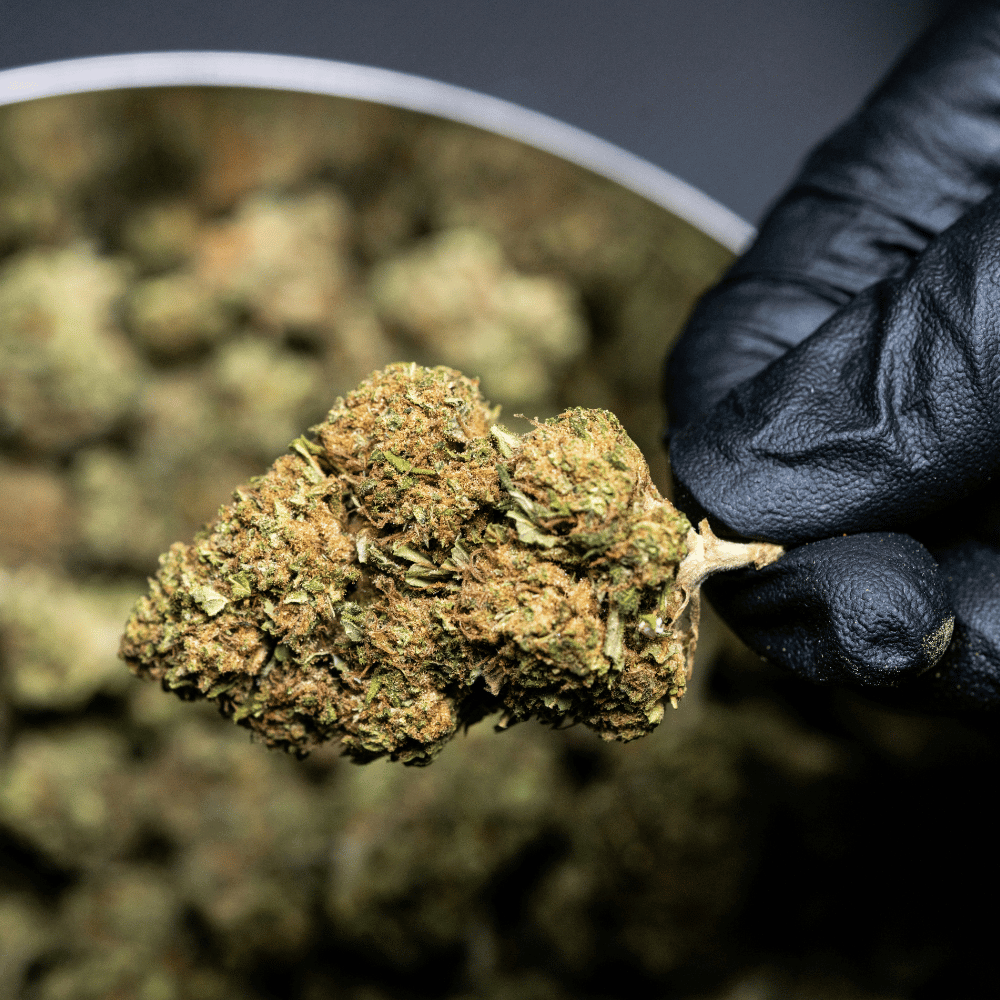
- Cannabis flower (fresh, not bone-dry, not wet)
- Grinder (highly recommended)
- Rolling papers (standard 1¼ is easiest to start with)
- Filter tips (pre-cut tips are easiest; paper tip works too)
Nice-to-haves (but optional)
- A rolling tray or clean flat surface
- A packing tool (or anything slim like a pen cap, toothpick, or dab tool)
- A lighter or hemp wick
If you do not want to roll at all, yes, you can skip the finger gymnastics and grab a Stilo pre-roll. Same vibe, zero homework. But if you’re here, you want the skill. Let’s build it.
Step 1: Choose the right paper (stop making it harder)
For beginners, use 1¼ size papers. They are forgiving. King size looks cool, but it is basically the “expert mode” of joints.
Pick a paper you like, but keep these basics in mind:
- Thinner papers burn slower and taste cleaner, but they can be harder to handle at first.
- Thicker papers are easier to roll, but can taste more “papery.”
Start with what’s easy. Become a wizard later.
Step 2: Grind the flower (this controls everything)
Grind your flower to a medium consistency.
- Too chunky: air gaps, uneven burn, constant relighting.
- Too fine (powdery): tight draw, harsh hits, clogged airflow.
If you do not have a grinder, you can break it up by hand, but be honest: it will be uneven. A grinder is the cheapest upgrade you can make for better joints.
Quick moisture check
- If your flower turns to dust: it is too dry.
- If it clumps into sticky balls and won’t separate: it is too moist.
Ideal flower feels springy and separates cleanly when pinched.
Step 3: Make a filter tip (do not skip this)
Yes, people roll without tips. Yes, those people also inhale crumbs and reshape soggy ends with regret.
A filter tip gives you:
- Better airflow
- A stable mouthpiece
- Less chance of pulling flower into your mouth
- A joint that keeps its shape
How to make a simple tip
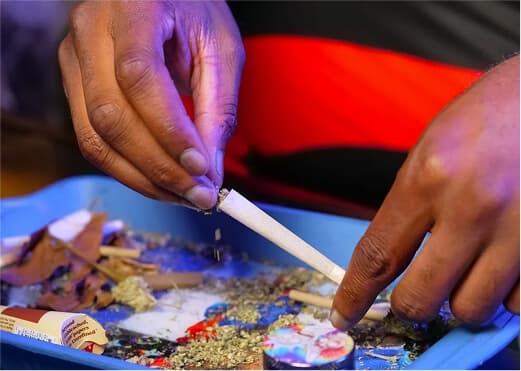
- Take a tip card (or a small strip of thicker paper).
- Make two or three small folds at one end like an accordion. This creates a little “W” or “M” shape.
- Roll the rest around those folds into a cylinder.
- Adjust the diameter so it fits your paper width comfortably.
Keep it snug, not crushed. It should hold shape but still allow airflow.
Step 4: Load the paper correctly (orientation matters)
Hold your rolling paper with:
- The gum strip facing you
- The gum strip on the top edge
- The paper forming a little hammock
Place the filter tip at one end. Most people place it on the left if right-handed, and on the right if left-handed. Do whatever keeps you coordinated.
Step 5: Add the flower (less than you think)
Sprinkle ground flower into the paper evenly, from tip to end.
For a beginner, start with a modest amount. Overstuffing is the most common mistake because it feels productive. It is not productive. It is chaos.
Shape it now, not later
Use your fingers to distribute the flower so it’s:
- Slightly denser near the tip
- Slightly looser toward the open end
That natural slope helps form a cone and makes the final tuck easier.
Step 6: The “taco” shape (pre-roll before you roll)
Before you try to tuck anything, shape the paper and flower into a cylinder.
- Pinch the paper lightly between your thumbs and index fingers.
- Rock it back and forth gently to settle the flower.
- Let the paper curve into a “U” shape.
You are not rolling yet. You are training the joint into a consistent tube. This is where beginners usually rush and then wonder why everything collapses.
Go slow. Rock it. Shape it. Rock it again.
Step 7: The tuck (this is the whole game)
Tucking is the hardest part. It is also the part that suddenly “clicks” after a few tries.
How to tuck without losing your mind
- With the joint shaped, use your thumbs to push the non-gummed edge of the paper inward, right between the flower and the filter.
- Start near the filter tip. Always start near the filter.
- Once you get that first tuck locked in, continue tucking along the length in small sections.
Think of it like zipping up a jacket. If the bottom is aligned, everything above it behaves.
If you cannot get the tuck, you probably have one of these issues:
- Too much flower
- Flower is too chunky
- Paper is not curved enough
- Your filter is too loose and sliding around
Fix the cause, not your luck.
Step 8: Roll upward and seal it (lick with purpose)
Once the tuck is in, roll the paper upward toward the gum strip. Keep pressure gentle and even.
When only the gum strip is left exposed:
- Lick the gum lightly. Do not soak it like you’re trying to drown it.
- Continue rolling to seal.
- Press along the seam to secure it.
A good seal looks smooth and flat. A bad seal looks like a wrinkled receipt and smokes about the same.
Step 9: Pack the open end (tighten without choking it)
You should have an open end at the top. Now you refine.
- Hold the joint upright, filter down.
- Tap it gently on a flat surface to settle the contents.
- Use a packing tool to lightly compress the top.
Do not ram it like you’re building a fence post. Overpacking kills airflow and turns your joint into a stubborn straw.
The airflow test (do this every time)
Take a gentle pull through the filter end before you twist the top.
- If it feels like sipping a milkshake through a coffee stirrer: too tight.
- If it feels like breathing through a wide-open tube: too loose.
Aim for easy, steady resistance.
Step 10: Twist the top (or fold it like a pro)
The classic finish is twisting the excess paper at the top into a little point.
Twist it snug, but not so tight you tear the paper.
If you prefer a cleaner finish, fold the excess paper inward in small creases to create a flat top. Twisting is simpler. Folding is fancy. Fancy can wait.
For those interested in exploring more about rolling techniques and terminology, refer to this comprehensive preroll glossary.
Step 11: Light it correctly (yes, there’s a right way)
A great joint can be ruined by bad lighting. Do not just torch one side and hope.
Do this instead
- Rotate the joint while applying flame near the tip to “toast” the edge evenly.
- Take a few small puffs to get an even cherry.
- If one side starts burning faster, slow down and rotate.
If your joint is canoeing, it is usually because of uneven packing, uneven grind, or aggressive lighting. Sometimes it is also because you are puffing like your rent is due in 30 seconds.
Take your time. Your joint will reward you.
Common beginner problems (and how to fix them fast)
Problem: It keeps going out
Fix: Pack slightly tighter, grind more evenly, and take steady puffs. Also check that your flower is not too moist.
Problem: It burns on one side (canoeing)
Fix: Even out the grind, distribute flower more consistently, and toast the light. If it starts canoeing, you can gently lick the fast-burning side and rotate as you puff. Yes, you are allowed to look a little ridiculous. It works.
Problem: The draw is too tight
Fix: You overpacked it, or your grind is too fine. Next time, use less pressure when packing and keep the grind medium. If it’s already rolled, gently roll it between your fingers to loosen it a touch.
Problem: Flower falls out of the mouth end
Fix: Use a filter tip. If you used a filter tip and this still happens, your filter is too loose or your grind is too fine.
Problem: The seam won’t stick
Fix: You licked too much or too little, or your fingers are covered in kief and regret. Wipe your fingertips, lick lightly, then press the seam firmly.
Problem: The joint looks lumpy
Fix: That is usually uneven distribution. Spend more time in the shaping step. Rock it. Shape it. Rock it again. Repetition, repetition.
The simplest “perfect joint” method for beginners (repeat this)
If you only remember one workflow, remember this:
- Grind medium.
- Make a solid filter.
- Load evenly and keep it modest.
- Shape the cylinder first.
- Tuck from the filter outward.
- Seal cleanly.
- Pack lightly and test airflow.
- Twist and toast.
Do it the same way every time. Consistency makes you good. Not vibes.
Want the easiest shortcut? Use a cone or buy a pre-roll
There is no award for suffering.
If you want the ritual without the rolling learning curve:
- Use a pre-rolled cone and just fill, pack, and twist.
- Or skip the DIY entirely and grab a Stilo pre-roll when you want a guaranteed, ready-to-go smoke.
Rolling is a skill. Pre-rolls are a convenience. You can enjoy both. You are allowed.
A quick note on responsible use
Start low, go slow. Especially if you are new, especially with higher potency flower. Hydrate. Sit down. Do not mix with alcohol if you do not know how you react. And once again for the people in the back: do not drive high.
Wrap-up: Roll it, burn it, learn it
How to roll the perfect joint is not a mystery. It is a routine. Grind evenly. Use a filter. Shape first. Tuck cleanly. Seal. Pack with restraint. Light like you mean it.
Then do it again. And again. Repetition, repetition.
And on the days you do not feel like practicing your finger choreography, do the sensible thing. Grab a Stilo pre-roll and get on with your life.
FAQs (Frequently Asked Questions)
What is the basic definition of a joint in cannabis rolling?
A joint is ground cannabis wrapped in rolling paper with a filter tip (also called a crutch) at one end, forming a cylinder that is evenly packed, not too tight or loose, sealed cleanly, and shaped smartly for smooth smoking.
What materials do I need to roll the perfect joint?
Essentials include fresh cannabis flower, a grinder (highly recommended), rolling papers (standard 1¼ size for beginners), and filter tips. Optional items are a rolling tray or clean flat surface, a packing tool like a pen cap or toothpick, and a lighter or hemp wick.
How do I choose the right rolling paper for beginners?
Beginners should start with 1¼ size papers as they are forgiving and easier to handle. Thinner papers burn slower and taste cleaner but can be harder to roll, while thicker papers are easier to roll but may taste more 'papery'. Start easy and become skilled over time.
Why is grinding cannabis flower important and how should it be done?
Grinding controls the consistency of your joint. Aim for medium consistency: not too chunky to avoid air gaps and uneven burns, and not too fine to prevent tight draws and clogged airflow. Use a grinder for best results; if breaking by hand, expect uneven pieces.
What is the purpose of using a filter tip in a joint?
A filter tip provides better airflow, creates a stable mouthpiece, prevents pulling cannabis crumbs into your mouth, and helps the joint keep its shape. Making simple accordion-folded tips from thicker paper strips is easy and highly recommended.
How should I load the rolling paper with flower for an ideal joint shape?
Hold the paper with the gum strip facing you on the top edge. Place the filter tip at one end (left if right-handed). Sprinkle less than you think evenly along the paper from tip to end. Shape flower slightly denser near the tip and looser toward the open end to form a beginner-friendly cone shape before rolling.
Jenna Renz
Jenna is a California-based creative copywriter who’s been lucky enough to have worked with a diverse range of clients before settling into the cannabis industry to explore her two greatest passions: writing and weed.

Related Articles
Long Beach Cannabis: Delivery vs Dispensary Pickup - Which Should You Choose?
Long Beach cannabis shopping comes down to one simple fork in the road: do you want it brought to you, or do you want to go get it yourself?
8 MinJune 22, 2026 Jenna Renz
Weed Delivery in Long Beach: Same-Day Cannabis, Zip Codes & How to Order
Weed delivery in Long Beach is the easiest way to get legal cannabis to your door fast, without circling for parking, waiting in line, or pretending you “just like the smell” in a dispensary lobby.
8 MinJune 22, 2026 Jenna Renz
What Does 'Craft Cannabis' Actually Mean? A Buyer's Guide
Craft cannabis is not a fancy way to say “expensive weed.” It’s a way to describe how the flower is grown, handled, and finished, from seed to jar. Think of it like bread. You can buy factory loaf or you can buy the sourdough your neighbor babysat for 36 hours and refuses to shut up about. Craft cannabis is the sourdough.
8 MinMay 22, 2026 Jenna Renz